
YouTube Video
Video not loading? Click here.
PyPSA stands for Python for Power System Analysis.
PyPSA is an open source Python package for simulating and optimising modern energy systems that include features such as
conventional generators with unit commitment (ramp-up, ramp-down, start-up, shut-down),
time-varying wind and solar generation,
energy storage with efficiency losses and inflow/spillage for hydroelectricity
coupling to other energy sectors (electricity, transport, heat, industry),
conversion between energy carriers (e.g. electricity to hydrogen),
transmission networks (AC, DC, other fuels)
PyPSA can be used for a variety of problem types (e.g. electricity market modelling, long-term investment planning, transmission network expansion planning), and is designed to scale well with large networks and long time series.
Compared to building power system by hand in linopy, PyPSA does the following things for you:
manage data inputs in standardised format
build standardised optimisation problem
communicate with the solver(s)
retrieve and process optimisation results
manage data outputs in standardised format
The documentation describes it as follows:
PyPSA is an open-source Python framework for optimising and simulating modern power and energy systems that include features such as conventional generators with unit commitment, variable wind and solar generation, hydro-electricity, inter-temporal storage, coupling to other energy sectors, elastic demands, and linearised power flow with loss approximations in DC and AC networks. PyPSA is designed to scale well with large networks and long time series. It is made for researchers, planners and utilities with basic coding aptitude who need a fast, easy-to-use and transparent tool for power and energy system analysis.
Key Dependencies
pandasfor storing data about network components and time seriesnumpyandscipyfor linear algebra and sparse matrix calculationsmatplotlibandcartopyfor plotting on a mapnetworkxfor network calculationslinopyfor handling optimisation problems
Basic Structure
| Component | Description |
|---|---|
| Network | Container for all components. |
| Bus | Node where components attach. |
| Carrier | Energy carrier or technology (e.g. electricity, hydrogen, gas, coal, oil, biomass, on-/offshore wind, solar). Can track properties such as specific carbon dioxide emissions or nice names and colors for plots. |
| Load | Energy consumer (e.g. electricity demand). |
| Generator | Generator (e.g. power plant, wind turbine, PV panel). |
| Line | Power distribution and transmission lines (overhead and cables). |
| Link | Links connect two buses with controllable energy flow, direction-control and losses. They can be used to model:
|
| StorageUnit | Storage with fixed nominal energy-to-power ratio. |
| GlobalConstraint | Constraints affecting many components at once, such as emission limits. |
| Store | Storage with separately extendable energy capacity. |
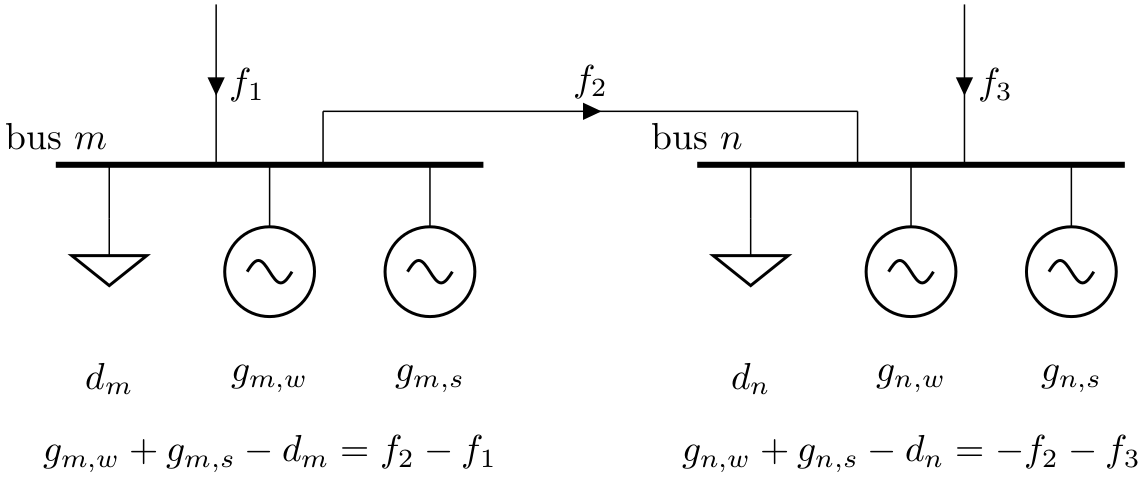
From structured data to optimisation
The design principle of PyPSA is that each component is associated with a set of variables and constraints that will be added to the optimisation model based on the input data stored for the components.
For an hourly electricity market simulation, PyPSA will solve an optimisation problem that looks like this
such that
Decision variables:
is the generator dispatch at bus , technology , time step ,
is the power flow in line ,
denotes the charge and discharge of storage unit at bus and time step ,
is the state of charge of storage at bus and time step .
Parameters:
is the marginal generation cost of technology at bus ,
is the reactance of transmission line ,
is the incidence matrix,
is the cycle matrix,
is the nominal capacity of the generator of technology at bus ,
is the rating of the transmission line ,
is the energy capacity of storage at bus ,
denote the standing (0), charging (1), and discharging (2) efficiencies.
Simple electricity market example
Let’s get acquainted with PyPSA to build a variant of one of the simple electricity market models we previously built in linopy.
We have the following data:
fuel costs in € / MWh
fuel_cost = dict(
    coal=8,
    gas=100,
    oil=48,
)
efficiencies of thermal power plants in MWh / MWh
efficiency = dict(
    coal=0.33,
    gas=0.58,
    oil=0.35,
)
specific emissions in t / MWh
# t/MWh thermal
emissions = dict(
    coal=0.34,
    gas=0.2,
    oil=0.26,
    hydro=0,
    wind=0,
)
power plant capacities in MW
power_plants = {
    "SA": {"coal": 35000, "wind": 3000, "gas": 8000, "oil": 2000},
    "MZ": {"hydro": 1200},
}
electrical load in MW
loads = {
    "SA": 42000,
    "MZ": 650,
}
Building a basic network
By convention, PyPSA is imported without an alias:
import pypsaFirst, we create a new network object which serves as the overall container for all components.
n = pypsa.Network()The second component we need are buses. Buses are the fundamental nodes of the network, to which all other components like loads, generators and transmission lines attach. They enforce energy conservation for all elements feeding in and out of it (i.e. Kirchhoff’s Current Law).
Components can be added to the network n using the n.add() function. It takes the component name as a first argument, the name of the component as a second argument and possibly further parameters as keyword arguments. Let’s use this function, to add buses for each country to our network:
n.add("Bus", "SA", y=-30.5, x=25, v_nom=400)
n.add("Bus", "MZ", y=-18.5, x=35.5, v_nom=400)
For each class of components, the data describing the components is stored in a pandas.DataFrame. For example, all static data for buses is stored in n.buses
n.busesYou see there are many more attributes than we specified while adding the buses; many of them are filled with default parameters which were added. You can look up the field description, defaults and status (required input, optional input, output) for buses here https://
The method n.add() also allows you to add multiple components at once. For instance, multiple carriers for the fuels with information on specific carbon dioxide emissions, a nice name, and colors for plotting. For this, the function takes the component name as the first argument and then a list of component names and then optional arguments for the parameters. Here, scalar values, lists, dictionary or pandas.Series are allowed. The latter two needs keys or indices with the component names.
n.add(
    "Carrier",
    ["coal", "gas", "oil", "hydro", "wind"],
    co2_emissions=emissions,
    nice_name=["Coal", "Gas", "Oil", "Hydro", "Onshore Wind"],
    color=["dimgrey", "tomato", "olive", "seagreen", "royalblue"],
)

n.add("Carrier", "AC", nice_name="Electricity", color="crimson")
The n.add() function is very general. It lets you add any component to the network object n. For instance, in the next step we add generators for all the different power plants.
In Mozambique:
n.add(
    "Generator",
    "MZ hydro",
    bus="MZ",
    carrier="hydro",
    p_nom=1200,  # MW
    marginal_cost=0,  # default
)
In South Africa (in a loop):
for tech, p_nom in power_plants["SA"].items():
    n.add(
        "Generator",
        f"SA {tech}",
        bus="SA",
        carrier=tech,
        efficiency=efficiency.get(tech, 1),
        p_nom=p_nom,
        marginal_cost=fuel_cost.get(tech, 0) / efficiency.get(tech, 1),
    )
As a result, the n.generators DataFrame looks like this:
n.generatorsNext, we’re going to add the electricity demand. This time, without a loop.
A positive value for p_set means consumption of power from the bus (in MW).
n.add(
    "Load",
    "SA electricity demand",
    bus="SA",
    p_set=loads["SA"],
    carrier="AC",
)
n.add(
"Load",
"MZ electricity demand",
bus="MZ",
p_set=loads["MZ"],
carrier="AC",
)n.loadsFinally, we add the connection between Mozambique and South Africa with a 500 MW line:
n.add(
    "Line",
    "SA-MZ",
    bus0="SA",
    bus1="MZ",
    s_nom=500,
    x=1,
    r=1,
)n.linesWe can have a sneak peek at the network we built with the n.plot() function.
n.plot(bus_size=1, margin=1);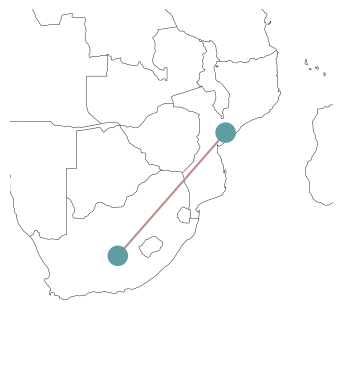
Or with its interactive sibling n.explore().
n.explore(bus_size=2e3, line_width=10)Optimisation
With all input data transferred into PyPSA’s data structure, we can now build and run the resulting optimisation problem. In PyPSA, building, solving and retrieving results from the optimisation model is contained in a single function call n.optimize(). This function optimizes the operational dispatch decisions for least cost, as well as investment decisions for components marked as extendable (more on this next time).
The n.optimize() function can take many arguments. The most relevant for the moment is the choice of the solver. We already know some solvers from the introduction to linopy (e.g. “highs” and “gurobi”). They need to be installed in your environment (e.g. conda), to use them here:
n.optimize(solver_name="highs", log_to_console=False)Output
INFO:linopy.model: Solve problem using Highs solver
INFO:linopy.model:Solver options:
 - log_to_console: False
INFO:linopy.io: Writing time: 0.03s
INFO:linopy.constants: Optimization successful:
Status: ok
Termination condition: optimal
Solution: 6 primals, 14 duals
Objective: 1.38e+06
Solver model: available
Solver message: Optimal
INFO:pypsa.optimization.optimize:The shadow-prices of the constraints Generator-fix-p-lower, Generator-fix-p-upper, Line-fix-s-lower, Line-fix-s-upper were not assigned to the network.
('ok', 'optimal')Let’s have a look at the results.
Since the power flow and dispatch are generally time-varying quantities, these are stored in a different location than e.g. n.generators. They are stored in n.generators_t. Thus, to find out the dispatch of the generators, run
n.generators_t.por if you prefer it in relation to the generators nominal capacity
n.generators_t.p / n.generators.p_nomYou see that the time index has the value ‘now’. This is the default index when no time series data has been specified and the network only covers a single state (e.g. a particular hour).
Similarly you will find the power flow in transmission lines at
n.lines_t.p0n.lines_t.p1The p0 will tell you the flow from bus0 to bus1. p1 will tell you the flow from bus1 to bus0.
What about the shadow prices?
n.buses_t.marginal_priceExplore the optimisation model
Under the hood, a call to n.optimize() builds a linopy optimisation model, solves it with the specified solver, and then retrieves the results back into the PyPSA data structure. We can access this intermediate linopy model via n.model. This allows us to explore the optimisation model in more detail, for instance to see all variables and constraints that were added to the optimisation problem.
n.modelLinopy LP model
===============
Variables:
----------
* Generator-p (snapshot, name)
* Line-s (snapshot, name)
Constraints:
------------
* Generator-fix-p-lower (snapshot, name)
* Generator-fix-p-upper (snapshot, name)
* Line-fix-s-lower (snapshot, name)
* Line-fix-s-upper (snapshot, name)
* Bus-nodal_balance (name, snapshot)
Status:
-------
okn.model.constraints["Generator-fix-p-upper"]Constraint `Generator-fix-p-upper` [snapshot: 1, name: 5]:
----------------------------------------------------------
[now, MZ hydro]: +1 Generator-p[now, MZ hydro] ≤ 1200.0
[now, SA coal]: +1 Generator-p[now, SA coal] ≤ 35000.0
[now, SA wind]: +1 Generator-p[now, SA wind] ≤ 3000.0
[now, SA gas]: +1 Generator-p[now, SA gas] ≤ 8000.0
[now, SA oil]: +1 Generator-p[now, SA oil] ≤ 2000.0n.model.constraints["Bus-nodal_balance"]Constraint `Bus-nodal_balance` [name: 2, snapshot: 1]:
------------------------------------------------------
[SA, now]: +1 Generator-p[now, SA coal] + 1 Generator-p[now, SA wind] + 1 Generator-p[now, SA gas] + 1 Generator-p[now, SA oil] - 1 Line-s[now, SA-MZ] = 42000.0
[MZ, now]: +1 Generator-p[now, MZ hydro] + 1 Line-s[now, SA-MZ] = 650.0n.model.objectiveObjective:
----------
LinearExpression: +0 Generator-p[now, MZ hydro] + 24.24 Generator-p[now, SA coal] + 0 Generator-p[now, SA wind] + 172.4 Generator-p[now, SA gas] + 137.1 Generator-p[now, SA oil]
Sense: min
Value: 1381391.2524257354n.model.constraints["Generator-fix-p-upper"].dual.to_dataframe()Basic network plotting
The results can also be visualised with PyPSA’s built-in plotting functions. The n.plot() function uses matplotlib to create static plots, while n.explore() creates interactive plots based on pydeck. In the following, we will focus on the interactive plotting with n.explore().
The n.explore() function has a variety of styling arguments to tweak the appearance of the buses, the lines and the map in the background. For example, we can size the buses according to their load:
s = n.loads.groupby("bus").p_set.sum()
s
bus
MZ 650.0
SA 42000.0
Name: p_set, dtype: float64n.explore(
bus_size=s,
bus_color="orange",
bus_alpha=1,
line_color="orchid",
line_width=30,
)The bus_size argument of n.explore() can be even more powerful.
The dispatch of each generator, we can find at:
n.generators_t.p.loc["now"]name
MZ hydro 1150.0
SA coal 35000.0
SA wind 3000.0
SA gas 1500.0
SA oil 2000.0
Name: now, dtype: float64If we group this by the bus and carrier and use it as bus_size, we can create pie charts at each bus showing the generation mix.
s = n.generators_t.p.loc["now"].groupby([n.generators.bus, n.generators.carrier]).sum()
s
bus carrier
MZ hydro 1150.0
SA coal 35000.0
gas 1500.0
oil 2000.0
wind 3000.0
Name: now, dtype: float64Additionally, we can show the line flows by specifying the line_flow argument.
n.explore(
    bus_size=s,
    line_width=30,
    line_flow=n.lines_t.p0.loc["now"] / 5,
)In the backend, the plotting function will look up the colors specified in n.carriers for each carrier and match it with the second index-level of s.
Modifying networks
Modifying data of components in an existing PyPSA network is as easy as modifying the entries of a pandas.DataFrame. For instance, if we want to reduce the cross-border transmission capacity between South Africa and Mozambique, we’d run:
n.lines.loc["SA-MZ", "s_nom"] = 400
n.linesn.optimize(log_to_console=False)Output
INFO:linopy.model: Solve problem using Highs solver
INFO:linopy.model:Solver options:
 - log_to_console: False
INFO:linopy.io: Writing time: 0.02s
INFO:linopy.constants: Optimization successful:
Status: ok
Termination condition: optimal
Solution: 6 primals, 14 duals
Objective: 1.40e+06
Solver model: available
Solver message: Optimal
INFO:pypsa.optimization.optimize:The shadow-prices of the constraints Generator-fix-p-lower, Generator-fix-p-upper, Line-fix-s-lower, Line-fix-s-upper were not assigned to the network.
('ok', 'optimal')You can see that the production of the hydro power plant was reduced and that of the gas power plant increased owing to the reduced transmission capacity.
n.generators_t.pGlobal constraints for emission limits
In the example above, we happen to have some spare gas capacity with lower carbon intensity than the coal and oil generators. We could use this to lower the emissions of the system, but it will be more expensive. We can implement the limit of carbon dioxide emissions as a constraint.
This is achieved in PyPSA through Global Constraints which add constraints that apply to many components at once.
But first, we need to calculate the current level of emissions to set a sensible limit.
We can compute the emissions per generator (in tonnes of CO) in the following way.
where is the specific emissions (tonnes/MWh thermal) and is the conversion efficiency (MWh electric / MWh thermal) of the generator with dispatch (MWh electric):
e = (
    n.generators_t.p
    / n.generators.efficiency
    * n.generators.carrier.map(n.carriers.co2_emissions)
)
eSummed up, we get total emissions in tonnes:
e.sum().sum()np.float64(38098.044484251375)So, let’s say we want to reduce emissions by 10%:
n.add(
    "GlobalConstraint",
    "emission_limit",
    carrier_attribute="co2_emissions",
    sense="<=",
    constant=e.sum().sum() * 0.9,
)n.optimize(log_to_console=False)Output
INFO:linopy.model: Solve problem using Highs solver
INFO:linopy.model:Solver options:
 - log_to_console: False
INFO:linopy.io: Writing time: 0.03s
INFO:linopy.constants: Optimization successful:
Status: ok
Termination condition: optimal
Solution: 6 primals, 15 duals
Objective: 2.12e+06
Solver model: available
Solver message: Optimal
INFO:pypsa.optimization.optimize:The shadow-prices of the constraints Generator-fix-p-lower, Generator-fix-p-upper, Line-fix-s-lower, Line-fix-s-upper were not assigned to the network.
('ok', 'optimal')n.generators_t.pn.generators_t.p / n.generators.p_nomn.global_constraints.muname
emission_limit -216.158537
Name: mu, dtype: float64Can we lower emissions even further? Say by another 5% points?
n.global_constraints.loc["emission_limit", "constant"] = 0.85n.optimize(log_to_console=False)Output
INFO:linopy.model: Solve problem using Highs solver
INFO:linopy.model:Solver options:
 - log_to_console: False
INFO:linopy.io: Writing time: 0.03s
WARNING:linopy.constants:Optimization potentially failed:
Status: warning
Termination condition: infeasible
Solution: 0 primals, 0 duals
Objective: nan
Solver model: available
Solver message: Infeasible
('warning', 'infeasible')No! Without any additional capacities, we have exhausted our options to reduce emissions in that hour. The solver tells us that the problem is infeasible, i.e. there is no solution that satisfies all constraints. Better revert this change:
n.global_constraints.loc["emission_limit", "constant"] = 0.9Data import and export
You may find yourself in a need to store PyPSA networks for later use. Or, maybe you want to import the genius PyPSA example that someone else uploaded to the web to explore.
Among other file formats, PyPSA can be stored as netCDF (.nc) file or as an Excel file (.xlsx). The approach is similar for all formats:
n.export_to_netcdf("tmp.nc");INFO:pypsa.network.io:Exported network 'Unnamed Network' saved to 'tmp.nc contains: loads, carriers, lines, sub_networks, buses, generators, global_constraints
n_nc = pypsa.Network("tmp.nc")/home/runner/work/data-science-for-esm/data-science-for-esm/.venv/lib/python3.13/site-packages/xarray/backends/plugins.py:109: RuntimeWarning: Engine 'cfgrib' loading failed:
Cannot find the ecCodes library
external_backend_entrypoints = backends_dict_from_pkg(entrypoints_unique)
INFO:pypsa.network.io:New version 1.2.1 available! (Current: 1.1.2)
INFO:pypsa.network.io:Imported network 'Unnamed Network' has buses, carriers, generators, global_constraints, lines, loads, sub_networks
A slightly more realistic example
Dispatch problem with German SciGRID network
SciGRID is a project that provides an open reference model of the European transmission network. The network comprises time series for loads and the availability of renewable generation at an hourly resolution for January 1, 2011 as well as approximate generation capacities in 2014. This dataset is a little out of date and only intended to demonstrate the capabilities of PyPSA.
n2 = pypsa.examples.scigrid_de()INFO:pypsa.network.io:Retrieving network data from https://github.com/PyPSA/PyPSA/raw/v1.1.2/examples/networks/scigrid-de/scigrid-de.nc.
INFO:pypsa.network.io:New version 1.2.1 available! (Current: 1.1.2)
INFO:pypsa.network.io:Imported network 'SciGrid-DE' has buses, carriers, generators, lines, loads, storage_units, transformers
There are some infeasibilities without allowing extension. Also, to approximate so-called security, we don’t allow any line to be loaded above 70% of their thermal rating. security is a constraint that states that no single transmission line may be overloaded by the failure of another transmission line (e.g. through a tripped connection).
n2.lines.s_max_pu = 0.7
n2.lines.loc[["316", "527", "602"], "s_nom"] = 1715
Because this network includes time-varying data, now is the time to look at another attribute of n: n.snapshots. Snapshots is the PyPSA terminology for time steps. In most cases, they represent a particular hour. They can be a pandas.DatetimeIndex or any other list-like attributes.
n2.snapshots[:4]DatetimeIndex(['2011-01-01 00:00:00', '2011-01-01 01:00:00',
'2011-01-01 02:00:00', '2011-01-01 03:00:00'],
dtype='datetime64[ns]', name='snapshot', freq=None)This index will match with any time-varying attributes of components:
n2.loads_t.p_set.iloc[:3, :3]We can use simple pandas syntax, to create an overview of the load time series...
n2.loads_t.p_set.sum(axis=1).plot(ylim=[0, 60e3], ylabel="MW")<Axes: xlabel='snapshot', ylabel='MW'>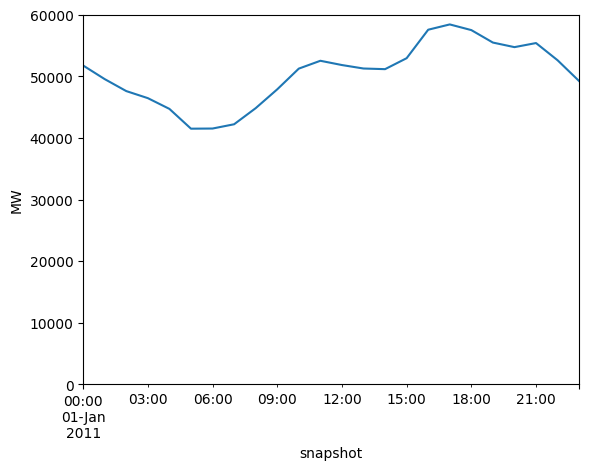
... and the capacity factor time series:
n2.generators_t.p_max_pu.T.groupby(n2.generators.carrier).mean().T.plot(ylabel="p.u.")<Axes: xlabel='snapshot', ylabel='p.u.'>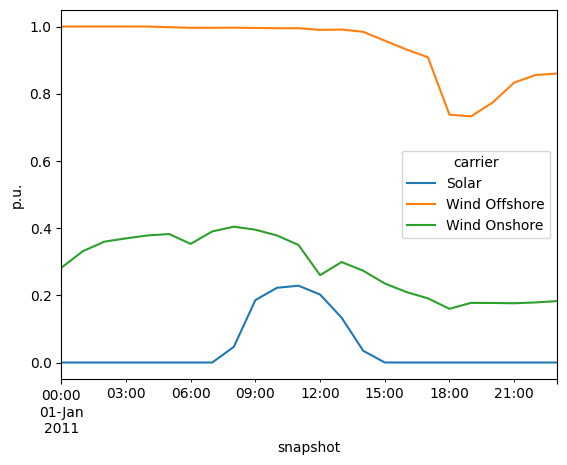
We can also inspect the total power plant capacities per technology...
n2.generators.groupby("carrier").p_nom.sum().div(1e3).sort_values().plot.barh(
    xlabel="GW"
)
<Axes: xlabel='GW', ylabel='carrier'>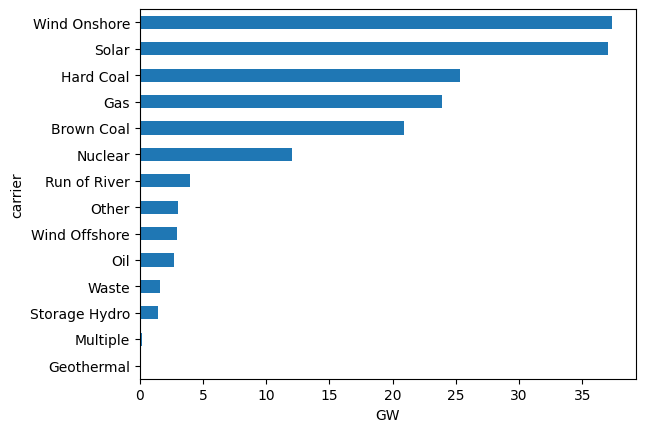
... and plot the regional distribution of loads...
load = n2.loads_t.p_set.sum(axis=0).groupby(n2.loads.bus).sum()
load.head(3)
bus
1 5417.262030
100_220kV 465.763014
101 1382.220699
dtype: float64n2.explore(bus_size=load / 20)... and power plant capacities...
capacities = n2.generators.groupby(["bus", "carrier"]).p_nom.sum()
capacities.head(3)
bus carrier
1 Gas 121.000000
Hard Coal 272.000000
Solar 79.674256
Name: p_nom, dtype: float64... for which we need to assign some colors to the technologies first:
colors = {
    "Gas": "tomato",
    "Hard Coal": "dimgrey",
    "Run of River": "turquoise",
    "Waste": "olive",
    "Brown Coal": "peru",
    "Oil": "black",
    "Storage Hydro": "teal",
    "Other": "whitesmoke",
    "Multiple": "whitesmoke",
    "Nuclear": "deeppink",
    "Geothermal": "darkorange",
    "Wind Offshore": "lightskyblue",
    "Wind Onshore": "royalblue",
    "Solar": "gold",
    "Pumped Hydro": "lightseagreen",
    "AC": "crimson",
}
n2.add("Carrier", colors.keys(), color=colors.values(), overwrite=True)
n2.explore(bus_size=capacities / 3)So let’s solve the electricity market simulation for January 1, 2011:
n2.optimize(log_to_console=False)Output
WARNING:pypsa.consistency:The following transformers have zero r, which could break the linear load flow:
Index(['2', '5', '10', '12', '13', '15', '18', '20', '22', '24', '26', '30',
       '32', '37', '42', '46', '52', '56', '61', '68', '69', '74', '78', '86',
       '87', '94', '95', '96', '99', '100', '104', '105', '106', '107', '117',
       '120', '123', '124', '125', '128', '129', '138', '143', '156', '157',
       '159', '160', '165', '184', '191', '195', '201', '220', '231', '232',
       '233', '236', '247', '248', '250', '251', '252', '261', '263', '264',
       '267', '272', '279', '281', '282', '292', '303', '307', '308', '312',
       '315', '317', '322', '332', '334', '336', '338', '351', '353', '360',
       '362', '382', '384', '385', '391', '403', '404', '413', '421', '450',
       '458'],
      dtype='object', name='name')
INFO:linopy.model: Solve problem using Highs solver
INFO:linopy.model:Solver options:
 - log_to_console: False
INFO:linopy.io:Writing objective.
Writing constraints.: 0%| | 0/15 [00:00<?, ?it/s]Writing constraints.: 87%|████████▋ | 13/15 [00:00<00:00, 114.53it/s]Writing constraints.: 100%|██████████| 15/15 [00:00<00:00, 79.44it/s]
Writing continuous variables.: 0%| | 0/6 [00:00<?, ?it/s]Writing continuous variables.: 100%|██████████| 6/6 [00:00<00:00, 289.74it/s]
INFO:linopy.io: Writing time: 0.22s
INFO:linopy.constants: Optimization successful:
Status: ok
Termination condition: optimal
Solution: 59640 primals, 142968 duals
Objective: 9.20e+06
Solver model: available
Solver message: Optimal
INFO:pypsa.optimization.optimize:The shadow-prices of the constraints Generator-fix-p-lower, Generator-fix-p-upper, Line-fix-s-lower, Line-fix-s-upper, Transformer-fix-s-lower, Transformer-fix-s-upper, StorageUnit-fix-p_dispatch-lower, StorageUnit-fix-p_dispatch-upper, StorageUnit-fix-p_store-lower, StorageUnit-fix-p_store-upper, StorageUnit-fix-state_of_charge-lower, StorageUnit-fix-state_of_charge-upper, Kirchhoff-Voltage-Law, StorageUnit-energy_balance were not assigned to the network.
('ok', 'optimal')Now, we can also plot model outputs, like the calculated power flows on the network map.
line_loading = (
    n2.lines_t.p0.iloc[0].abs() / n2.lines.s_nom / n2.lines.s_max_pu * 100
)  # %
n2.explore(
bus_size=1e1,
line_color=line_loading.abs(),
line_flow=n2.lines_t.p0.iloc[0] / 100,
line_cmap="plasma",
line_width=n2.lines.s_nom / 1000,
)Or plot the hourly dispatch using PyPSA’s built-in statistics functionality:
n2.statistics.energy_balance.iplot()Statistics
The PyPSA n.statistics module provides a variety of pre-defined tables and plots to analyse optimisation results at different aggregation levels. For instance, the energy balance, the operational costs (OPEX), curtailment, prices and market value. We will use this module in more detail in later workshops on sector coupling and investment optimisation.
Energy balance:
n2.statistics.energy_balance().div(1e3).round(1).sort_values()component carrier bus_carrier
Load - AC -1210.0
StorageUnit Pumped Hydro AC -2.7
Generator Geothermal AC 0.2
Other AC 3.7
Gas AC 5.5
Storage Hydro AC 25.3
Wind Offshore AC 31.0
Waste AC 33.5
Solar AC 46.3
Run of River AC 83.0
Nuclear AC 176.6
Hard Coal AC 185.4
Brown Coal AC 215.2
Wind Onshore AC 407.1
dtype: float64Operational costs (OPEX):
n2.statistics.opex().round(1).sort_values(ascending=False)component carrier
Generator Hard Coal 4634772.9
Brown Coal 2151669.5
Nuclear 1412597.8
Gas 276634.6
Run of River 248924.6
Waste 200916.7
Other 117165.7
StorageUnit Pumped Hydro 75904.9
Generator Storage Hydro 75896.4
Geothermal 4804.8
dtype: float64There is much more to explore in PyPSA. If you are hooked, have a look at the documentation and the examples section.
Exercises
Modify some of the input data of the South Africa - Mozambique network n, first removing the emission limit global constraint:
n.remove("GlobalConstraint", "emission_limit")Task 1: Model an outage of the transmission line by removing it. How does the model compensate for the lack of transmission?
Notebook Cell
n.model.solver_model = None
n_t1 = n.copy()

n_t1.remove("Line", "SA-MZ")
n_t1.optimize(log_to_console=False)
INFO:linopy.model: Solve problem using Highs solver
INFO:linopy.model:Solver options:
 - log_to_console: False
INFO:linopy.io: Writing time: 0.02s
INFO:linopy.constants: Optimization successful:
Status: ok
Termination condition: optimal
Solution: 5 primals, 12 duals
Objective: 1.47e+06
Solver model: available
Solver message: Optimal
INFO:pypsa.optimization.optimize:The shadow-prices of the constraints Generator-fix-p-lower, Generator-fix-p-upper were not assigned to the network.
('ok', 'optimal')Notebook Cell
n_t1.statistics.energy_balance().astype(int).sort_values()component carrier bus_carrier
Load Electricity Electricity -42650
Generator Hydro Electricity 650
Oil Electricity 2000
Gas Electricity 2000
Onshore Wind Electricity 3000
Coal Electricity 35000
dtype: int64Task 2: Double the wind capacity. How is the electricity price in South Africa affected? What generator is price-setting?
Notebook Cell
n.model.solver_model = None
n_t2 = n.copy()

n_t2.generators.loc["SA wind", "p_nom"] *= 2
n_t2.optimize(log_to_console=False)
INFO:linopy.model: Solve problem using Highs solver
INFO:linopy.model:Solver options:
 - log_to_console: False
INFO:linopy.io: Writing time: 0.02s
INFO:linopy.constants: Optimization successful:
Status: ok
Termination condition: optimal
Solution: 6 primals, 14 duals
Objective: 9.31e+05
Solver model: available
Solver message: Optimal
INFO:pypsa.optimization.optimize:The shadow-prices of the constraints Generator-fix-p-lower, Generator-fix-p-upper, Line-fix-s-lower, Line-fix-s-upper were not assigned to the network.
('ok', 'optimal')Notebook Cell
price = n_t2.buses_t.marginal_price
priceNotebook Cell
n_t2.generators.loc[
    n.generators.marginal_cost.round(2) == price.at["now", "SA"].round(2)
].index[0]
'SA oil'Task 3: South Africa brings a new 1000 MW nuclear power plant into operation with an estimated marginal electricity generation cost of 20 €/MWh. Will that affect the electricity price?
Notebook Cell
n.model.solver_model = None
n_t3 = n.copy()

n_t3.add(
    "Generator",
    "SA nuclear",
    bus="SA",
    carrier="nuclear",
    p_nom=1000,
    marginal_cost=20,
)
n_t3.optimize(log_to_console=False)
WARNING:pypsa.consistency:The following generators have carriers which are not defined. Run n.sanitize() to add them. Components with undefined carriers:
Index(['SA nuclear'], dtype='object', name='name')
INFO:linopy.model: Solve problem using Highs solver
INFO:linopy.model:Solver options:
 - log_to_console: False
INFO:linopy.io: Writing time: 0.03s
INFO:linopy.constants: Optimization successful:
Status: ok
Termination condition: optimal
Solution: 7 primals, 16 duals
Objective: 1.25e+06
Solver model: available
Solver message: Optimal
INFO:pypsa.optimization.optimize:The shadow-prices of the constraints Generator-fix-p-lower, Generator-fix-p-upper, Line-fix-s-lower, Line-fix-s-upper were not assigned to the network.
('ok', 'optimal')Notebook Cell
n_t3.buses_t.marginal_price